
Cloud/ Devops Engineering-Modern Infrastructure for Scalable Applications

DevOps has revolutionized how organizations build, deploy, and maintain applications in the cloud. By breaking down silos between development and operations teams, DevOps enables faster delivery cycles, improved reliability, and better resource utilization. Cloud platforms like AWS, Azure, and Google Cloud have accelerated this transformation, providing the foundation for modern engineering practices that prioritize automation, monitoring, and continuous improvement. The CI/CD Pipeline: Automating Deployment Continuous Integration and Continuous Deployment (CI/CD) form the backbone of modern DevOps practices. These pipelines automate the testing, building, and deployment of code, significantly reducing manual errors and deployment times. Tools like Jenkins, GitLab CI, and GitHub Actions enable teams to push code changes multiple times daily with confidence. A well-designed CI/CD pipeline ensures that every code change goes through automated testing before reaching production, dramatically improving software quality and reducing time-to-market. Key Benefits Automated testing catches bugs early Faster release cycles reduce time-to-value Consistent deployment processes minimize human error Quick rollback capabilities when issues arise Containerization and Kubernetes: Scalable Infrastructure Docker revolutionized application deployment by enabling containerization—packaging applications with their dependencies in lightweight, portable containers. Kubernetes emerged as the industry standard for orchestrating these containers at scale, managing resource allocation, scaling, and self-healing capabilities across clusters. Organizations using Kubernetes can automatically scale applications based on demand, ensuring optimal resource utilization and cost efficiency. Container registries store these images, making deployment reproducible and consistent across development, staging, and production environments. This approach significantly reduces the “works on my machine” problem that has plagued software development for years. Infrastructure-as-Code and Automation Infrastructure-as-Code (IaC) treats infrastructure configuration as versioned, reviewable code. Tools like Terraform, CloudFormation, and Ansible enable teams to define cloud resources programmatically, ensuring consistency and repeatability. This approach brings the rigor of software development practices to infrastructure management. Automation extends beyond deployment to encompassing monitoring, alerting, and even auto-remediation. By codifying infrastructure and operational procedures, teams reduce manual configuration errors, enable faster disaster recovery, and create auditable records of all changes. Version control systems track every modification, providing accountability and enabling quick rollbacks if needed. Monitoring, Logging, and Observability Modern cloud applications require comprehensive visibility into system behavior. Monitoring tools like Prometheus and Datadog track performance metrics, while centralized logging solutions such as ELK Stack and Splunk aggregate logs from distributed systems. Observability—combining metrics, logs, and traces—provides deep insights into application health and performance. Effective monitoring enables proactive problem detection, reducing mean time to resolution (MTTR). Alerting systems notify teams of anomalies before users experience issues, while dashboards provide real-time visibility into system status. This data-driven approach transforms operations from reactive firefighting to proactive optimization. Conclusion Cloud and DevOps engineering represent a fundamental shift in how organizations deliver software. By embracing automation, containerization, and infrastructure-as-code, companies achieve faster delivery cycles, improved reliability, and better resource efficiency. As cloud platforms continue evolving, mastering these practices becomes essential for competitive advantage in the digital era. Sources and References The Phoenix Project: A Novel about IT, DevOps, and Helping Your Business Win Comprehensive guide to container orchestration
Exploring the Dynamic World of AI and Machine Learning

Artificial Intelligence (AI) and Machine Learning (ML) have transformed from buzzwords into essential pillars driving innovation across industries. Whether you’re a tech enthusiast or a professional, understanding these technologies opens doors to countless opportunities. Today’s blog delves into the core concepts, applications, and future potential of AI and ML, making the complex accessible and exciting. Understanding AI and Machine Learning At its heart, Artificial Intelligence is about creating systems that can perform tasks usually requiring human intelligence, such as decision-making and problem-solving. Machine Learning, a subset of AI, enables systems to learn from data and improve without explicit programming. Key terms like deep learning, neural networks, and natural language processing play critical roles in these advancements. Key applications shaping our world AI and ML are no longer confined to laboratories—they are actively reshaping everyday life. From autonomous vehicles navigating our streets to personalized recommendations on streaming platforms, these technologies enhance convenience and efficiency. Industries such as healthcare leverage AI for diagnostics, while finance uses it for fraud detection and algorithmic trading. Challenges and the Road Ahead Despite rapid progress, AI and ML come with challenges including data privacy, ethical considerations, and the need for transparent algorithms. As researchers work to address these issues, the future promises even more sophisticated AI systems capable of creative problem-solving and nuanced understanding. Staying informed about trends like explainable AI and reinforcement learning is crucial for anyone interested in this field. AI and Machine Learning are not just trends; they are transformative forces shaping our future. Embracing their potential responsibly will unlock innovations that benefit society on a global scale. For further reading and insights, explore resources like IBM’s AI Overview and Machine Learning Mastery. Stay curious, keep learning, and join the conversation on how AI and ML continue to evolve and impact our world. Sources and References Machine Learning Mastery Towards Data Science (General AI & ML resource)
High-Performance Computing-Unleashing Computational Power for the Future
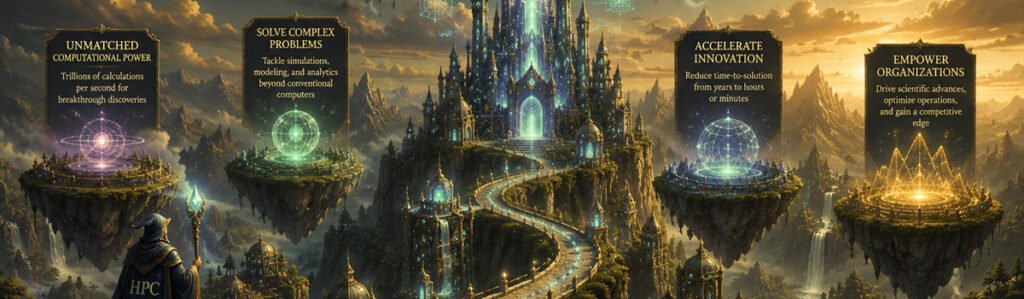
High-Performance Computing (HPC) represents the pinnacle of computational capability, enabling organizations to solve complex problems that would be impossible with conventional computers. From climate modeling to drug discovery, HPC systems process massive datasets at extraordinary speeds, transforming industries and accelerating scientific breakthroughs. The Evolution of HPC Technology The journey of HPC has been marked by exponential growth in processing power. Today’s supercomputers perform calculations at exascale levels—achieving billions of billions of floating-point operations per second. This dramatic increase has been driven by advances in processor architecture, improved cooling systems, and innovative software frameworks that maximize computational efficiency. Modern HPC clusters combine thousands of processors working in parallel, connected through high-speed networks that enable seamless data exchange. The National Supercomputing Center and leading research institutions worldwide leverage these systems to tackle humanity’s greatest challenges, from understanding disease mechanisms to simulating nuclear reactions without physical testing. Applications and Real-World Impact HPC’s applications span virtually every scientific and industrial domain. In pharmaceutical research, supercomputers accelerate drug discovery by simulating molecular interactions billions of times faster than traditional methods. Financial institutions use HPC for risk analysis and algorithmic trading, processing market data in microseconds. Weather forecasting relies heavily on HPC to integrate satellite data and model atmospheric behavior with remarkable precision. Artificial intelligence and machine learning have become primary HPC consumers. Training advanced neural networks requires massive computational resources that only supercomputers can provide. Companies like OpenAI and DeepMind depend on HPC infrastructure to develop cutting-edge AI models. Additionally, automotive manufacturers employ HPC for crash simulations and aerodynamic optimization, reducing design cycles and improving safety. The Rise of GPU-Accelerated Computing Graphics Processing Units (GPUs) have revolutionized HPC by offering unprecedented parallel processing capabilities. Originally designed for gaming and graphics rendering, GPUs proved exceptionally suited for scientific computing. A single GPU can handle thousands of threads simultaneously, making them ideal for the massive parallelism HPC demands. GPU-accelerated clusters now dominate supercomputer rankings globally. The NVIDIA H100 and AMD MI300 GPUs have become industry standards, providing researchers with accessible pathways to supercomputing power. Cloud providers like AWS, Google Cloud, and Microsoft Azure now offer GPU-accelerated HPC services, democratizing access to what was once exclusive technology reserved for elite research institutions. Challenges and Future Directions Despite remarkable progress, HPC faces significant challenges. Energy consumption remains a critical concern—the world’s fastest supercomputers require megawatts of power. Researchers are exploring more energy-efficient architectures and cooling innovations to sustain growth toward exascale and beyond. Software complexity presents another hurdle. Developing applications that effectively utilize thousands of processors requires specialized expertise and sophisticated programming frameworks like MPI and OpenMP. The talent shortage in HPC software development threatens to limit innovation. Looking ahead, exascale computing promises capabilities a thousand times greater than current systems. Projects like the EU’s Exascale Computing Partnership and the U.S. Department of Energy’s initiatives are driving toward this frontier, enabling simulations and analyses previously thought impossible. Conclusion High-Performance Computing stands as a cornerstone technology for scientific progress and industrial innovation. As computational demands continue escalating, HPC systems will become increasingly essential for addressing climate change, advancing medicine, and pushing the boundaries of human knowledge. Organizations investing in HPC capabilities today are positioning themselves at the forefront of technological revolution. Sources and References High-Performance Computing news and industry insights
The Future of Data Engineering: Leveraging AI Powered Integration Solutions

Data engineering has undergone a dramatic transformation over the past few years. As organizations generate unprecedented volumes of data, manual approaches to integration and pipeline management have become increasingly untenable. AI-powered data engineering represents a paradigm shift—automating complex workflows, enhancing data quality, and enabling real-time insights at scale. This blog explores how artificial intelligence is revolutionizing data engineering and integration, offering practical benefits that span from reduced operational overhead to superior analytical capabilities. What is ai-powered data engineering? AI-powered data engineering combines machine learning, automation, and intelligent algorithms to streamline the entire data lifecycle. Rather than relying solely on hand-coded ETL processes, modern data platforms leverage AI to: Automatically detect data schemas and transformations without manual specification. Predict data quality issues before they propagate downstream. Optimize pipeline performance by analyzing execution patterns and resource allocation. Learn from historical data patterns to improve integration accuracy and consistency. Organizations like Forrester Research and Gartner have identified intelligent data integration as a critical capability for competitive advantage. Leading platforms such as Talend, Informatica, and DBT Labs now incorporate machine learning to automate traditionally labor-intensive tasks. Key Benefits of Intelligent Integration Accelerated time-to-insights AI-driven automation reduces the time required to move raw data from source systems to analytics platforms. Automated discovery, mapping, and validation eliminate bottlenecks that historically consumed weeks of engineering effort. Real-time data orchestration ensures stakeholders access current information within minutes rather than days. Enhanced data quality and governance Machine learning models trained on historical datasets can identify anomalies, inconsistencies, and data drift in real-time. Predictive quality monitoring flags potential issues before they impact downstream applications, maintaining trust in analytics outcomes. Automated data lineage tracking provides governance teams with comprehensive audit trails—critical for regulatory compliance in healthcare, finance, and insurance sectors. Cost reduction and scalability By automating routine maintenance and optimization tasks, AI-powered platforms significantly reduce the headcount required to manage complex data ecosystems. Organizations can scale their data operations without proportionally scaling their teams. Self-healing pipelines that recover from failures autonomously reduce incident response time and associated costs. Real-World Applications and Future Outlook, Current Industry Adoption. Enterprise data teams are already leveraging AI for: Automated schema discovery in heterogeneous source systems. Anomaly detection in financial transactions and IoT sensor data. Intelligent caching and query optimization in data warehouses. Predictive maintenance for data pipeline stability. According to a 2024 Gartner report on data engineering platforms, organizations implementing intelligent data integration report a 40% reduction in time-to-production and a 35% decrease in manual coding errors. Looking ahead The convergence of generative AI and data engineering will further accelerate adoption. Natural language interfaces will enable business analysts to construct complex data workflows without coding expertise. Autonomous data systems will self-optimize based on evolving business requirements, representing the next evolution in the data stack. Getting started with ai-powered data engineering Recommended Resources: Apache Airflow Documentation – Open-source workflow orchestration with growing ML integration. Databricks Lakehouse Platform – AI-native data platform combining data warehousing and machine learning. AWS Glue – Serverless ETL with automated schema discovery. Google Cloud Dataflow – Stream and batch processing with intelligent resource optimization. Action Steps: Audit your current data integration architecture for automation opportunities. Evaluate cloud-native platforms that embed machine learning capabilities. Pilot an intelligent integration solution on a non-critical pipeline. Measure success metrics: time-to-production, error rates, operational costs. Conclusion AI-powered data engineering is no longer aspirational—it’s becoming essential infrastructure for data-driven organizations. By automating complex workflows, enhancing data quality, and enabling predictive maintenance, intelligent integration platforms deliver measurable business value. Whether you’re managing dozens of data sources or thousands, now is the time to evaluate how AI can transform your data engineering practice. Sources and References Gartner Report: “Magic Quadrant for Cloud Data Integration Tools” (2024)
Unlocking the Future – An Introduction to Quantum Computing

Quantum computing is no longer just a futuristic concept—it’s rapidly becoming a transformative technology that promises to revolutionize how we solve complex problems. From cryptography to drug discovery, quantum computers can tackle challenges that classical computers struggle with, thanks to their unique approach to processing information. In this blog, we’ll explore the essentials of quantum computing, its potential impact, and why it’s capturing the imagination of scientists and tech enthusiasts worldwide. What is Quantum computing? At its core, quantum computing harnesses the principles of quantum mechanics to process information. Unlike classical bits, which are either a 0 or a 1, quantum bits or qubits can exist in multiple states simultaneously thanks to superposition. This means a quantum computer can explore many possibilities at once, offering an exponential increase in computational power for certain tasks. Another key phenomenon is entanglement, where qubits become interconnected so that the state of one instantly influences the state of another, no matter the distance between them. These properties enable quantum algorithms to solve complex problems more efficiently than classical algorithms. Applications and Impact Quantum computing is poised to disrupt several fields: Cryptography: Quantum computers can potentially break many of today’s encryption methods, driving the need for new quantum-safe cryptographic techniques. Optimization: Industries like logistics and finance can benefit from faster and more accurate optimization of routes, portfolios, and supply chains. Drug Discovery: Simulating molecules at the quantum level can accelerate the development of new medicines and materials. Artificial Intelligence: Quantum algorithms can enhance machine learning by processing vast datasets more efficiently. Challenges on the Horizon Despite its promise, quantum computing faces significant hurdles. Qubit stability remains a challenge as they are highly sensitive to environmental disturbances, leading to errors. Researchers are also working on scaling up the number of qubits to create practical, large-scale quantum computers. The field is still in its infancy but progressing rapidly. There’s also the question of accessibility and how soon this technology will become mainstream. For now, quantum computing is mostly in the hands of large corporations, governments, and academic institutions, but efforts to democratize it are underway. Looking ahead Quantum computing is set to be a game-changer in the tech landscape. While we may still be years away from fully realizing its potential, its foundations are reshaping how we think about computation and problem-solving. Whether you’re a tech enthusiast or just curious about the future, keeping an eye on quantum advancements is both exciting and essential. Stay tuned for more explorations into emerging technologies in our upcoming posts! Sources and References Quantum Computing for the Very Curious Nature: The race for quantum advantage
Cyber Security Essentials – Protecting your Digital Future

As technology advances, our world is becoming more digital and connected. Cyber security has become a critical concern for individuals and organisations alike. With cyber threats evolving at an unprecedented pace, understanding the fundamentals of digital protection is no longer optional—it’s essential. This blog explores key cyber-security concepts that can help you safeguard your valuable data and systems. Understanding the cyber threat landscape The digital landscape is fraught with dangers that range from sophisticated ransomware attacks to simple phishing schemes. Organisations lose billions annually to cyber-attacks, and the average data breach costs over $4 million. The threat landscape includes: Ransomware: Malicious software that encrypts data and demands payment for restoration Phishing Attacks: Fraudulent attempts to steal credentials through deceptive emails or messages Zero-Day Exploits: Attacks targeting previously unknown vulnerabilities Insider Threats: Malicious activities from employees or trusted partners Understanding these threats is the first step toward building a robust cyber Défense strategy that protects both your immediate infrastructure and long-term organisational reputation. Core Security Measures and Best Practices Implementing fundamental security measures can dramatically reduce your vulnerability to cyber-attacks. The cornerstone of modern cyber-security is a layered approach combining multiple protective strategies : Multi-Factor Authentication (MFA): Requiring multiple verification methods (passwords, bio-metrics, security keys) significantly reduces unauthorised access attempts. Studies show that MFA can block 99.9% of account compromise attacks. Data Encryption: Converting sensitive information into encoded formats ensures that even if data is intercepted, it remains unreadable without proper decryption keys. Both in-transit and at-rest encryption are essential. Zero-Trust Security: This model operates on the principle that no user or system should be trusted by default, regardless of their location or past authentication history. Every access request must be verified. Network Segmentation: Dividing your network into isolated zones limits the lateral movement of attackers, containing breaches to specific areas. Threat Detection Systems: Advanced monitoring tools identify suspicious patterns and potential breaches in real-time, enabling rapid response before significant damage occurs. Comprehensive Cyber Defense Strategy. Developing a comprehensive cyber-security program requires coordination across technology, people, and processes. Organisations must invest in: Regular security awareness training for all employees, continuous vulnerability assessments Incident response plans and regular drills. Collaboration and updating with cyber-security professionals and consultants. The key to effective cyber Defense is recognising that security is an ongoing journey, not a destination. Threats evolve constantly. Sources and References National Institute of Standards and Technology (NIST) Cybersecurity and Infrastructure Security Agency (CISA)


