
Exploring the Dynamic World of AI and Machine Learning

Artificial Intelligence (AI) and Machine Learning (ML) have transformed from buzzwords into essential pillars driving innovation across industries. Whether you’re a tech enthusiast or a professional, understanding these technologies opens doors to countless opportunities. Today’s blog delves into the core concepts, applications, and future potential of AI and ML, making the complex accessible and exciting. Understanding AI and Machine Learning At its heart, Artificial Intelligence is about creating systems that can perform tasks usually requiring human intelligence, such as decision-making and problem-solving. Machine Learning, a subset of AI, enables systems to learn from data and improve without explicit programming. Key terms like deep learning, neural networks, and natural language processing play critical roles in these advancements. Key applications shaping our world AI and ML are no longer confined to laboratories—they are actively reshaping everyday life. From autonomous vehicles navigating our streets to personalized recommendations on streaming platforms, these technologies enhance convenience and efficiency. Industries such as healthcare leverage AI for diagnostics, while finance uses it for fraud detection and algorithmic trading. Challenges and the Road Ahead Despite rapid progress, AI and ML come with challenges including data privacy, ethical considerations, and the need for transparent algorithms. As researchers work to address these issues, the future promises even more sophisticated AI systems capable of creative problem-solving and nuanced understanding. Staying informed about trends like explainable AI and reinforcement learning is crucial for anyone interested in this field. AI and Machine Learning are not just trends; they are transformative forces shaping our future. Embracing their potential responsibly will unlock innovations that benefit society on a global scale. For further reading and insights, explore resources like IBM’s AI Overview and Machine Learning Mastery. Stay curious, keep learning, and join the conversation on how AI and ML continue to evolve and impact our world. Sources and References Machine Learning Mastery Towards Data Science (General AI & ML resource)
High-Performance Computing-Unleashing Computational Power for the Future
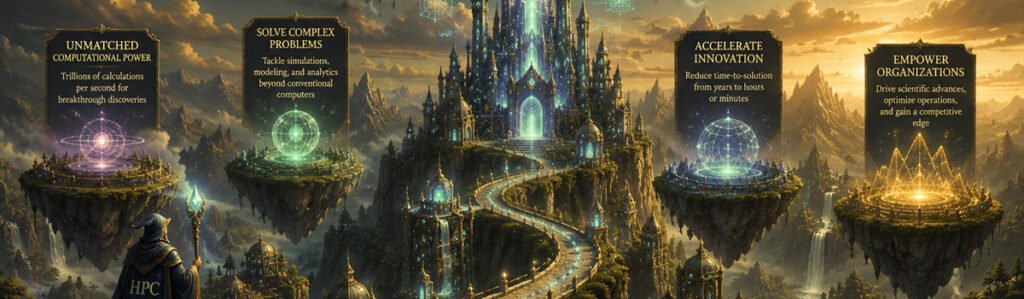
High-Performance Computing (HPC) represents the pinnacle of computational capability, enabling organizations to solve complex problems that would be impossible with conventional computers. From climate modeling to drug discovery, HPC systems process massive datasets at extraordinary speeds, transforming industries and accelerating scientific breakthroughs. The Evolution of HPC Technology The journey of HPC has been marked by exponential growth in processing power. Today’s supercomputers perform calculations at exascale levels—achieving billions of billions of floating-point operations per second. This dramatic increase has been driven by advances in processor architecture, improved cooling systems, and innovative software frameworks that maximize computational efficiency. Modern HPC clusters combine thousands of processors working in parallel, connected through high-speed networks that enable seamless data exchange. The National Supercomputing Center and leading research institutions worldwide leverage these systems to tackle humanity’s greatest challenges, from understanding disease mechanisms to simulating nuclear reactions without physical testing. Applications and Real-World Impact HPC’s applications span virtually every scientific and industrial domain. In pharmaceutical research, supercomputers accelerate drug discovery by simulating molecular interactions billions of times faster than traditional methods. Financial institutions use HPC for risk analysis and algorithmic trading, processing market data in microseconds. Weather forecasting relies heavily on HPC to integrate satellite data and model atmospheric behavior with remarkable precision. Artificial intelligence and machine learning have become primary HPC consumers. Training advanced neural networks requires massive computational resources that only supercomputers can provide. Companies like OpenAI and DeepMind depend on HPC infrastructure to develop cutting-edge AI models. Additionally, automotive manufacturers employ HPC for crash simulations and aerodynamic optimization, reducing design cycles and improving safety. The Rise of GPU-Accelerated Computing Graphics Processing Units (GPUs) have revolutionized HPC by offering unprecedented parallel processing capabilities. Originally designed for gaming and graphics rendering, GPUs proved exceptionally suited for scientific computing. A single GPU can handle thousands of threads simultaneously, making them ideal for the massive parallelism HPC demands. GPU-accelerated clusters now dominate supercomputer rankings globally. The NVIDIA H100 and AMD MI300 GPUs have become industry standards, providing researchers with accessible pathways to supercomputing power. Cloud providers like AWS, Google Cloud, and Microsoft Azure now offer GPU-accelerated HPC services, democratizing access to what was once exclusive technology reserved for elite research institutions. Challenges and Future Directions Despite remarkable progress, HPC faces significant challenges. Energy consumption remains a critical concern—the world’s fastest supercomputers require megawatts of power. Researchers are exploring more energy-efficient architectures and cooling innovations to sustain growth toward exascale and beyond. Software complexity presents another hurdle. Developing applications that effectively utilize thousands of processors requires specialized expertise and sophisticated programming frameworks like MPI and OpenMP. The talent shortage in HPC software development threatens to limit innovation. Looking ahead, exascale computing promises capabilities a thousand times greater than current systems. Projects like the EU’s Exascale Computing Partnership and the U.S. Department of Energy’s initiatives are driving toward this frontier, enabling simulations and analyses previously thought impossible. Conclusion High-Performance Computing stands as a cornerstone technology for scientific progress and industrial innovation. As computational demands continue escalating, HPC systems will become increasingly essential for addressing climate change, advancing medicine, and pushing the boundaries of human knowledge. Organizations investing in HPC capabilities today are positioning themselves at the forefront of technological revolution. Sources and References High-Performance Computing news and industry insights


